

AFTER THE EARTHLY HELL, EVERYTHING WENT SILENT
By ZETENY CSERESZNYES
The 80th Liberation Day is approaching. Around 80 years ago, in the late winter and early spring of 1945, Hungarians and other Europeans were freed from nazi occupation and terror, but many had to realize soon that the liberation by the soviet army meant another invasion. Due to political pressure, the crimes of the invading soldiers had been unspeakable for decades. Several hundred thousand people suffered sexual abuse, and more were deported for forced labor to Siberia. Under the socialist state, it became unquestionable that all previous regimes were inherently evil, the soviet liberation was heroic, April 4th became the symbol of freedom, while generations grew up in Hungary unaware of what their own family went through during the liberation. After the regime change of 1989, some people broke their silence and its interpretation has been reversed. The pressure of the political understanding of this period deprived people from making sense of its significance and forced the topic into pure abstraction.
To understand what many people suffered, and what liberation meant to them, it is crucial to put stories in their context from the unfolding of the terror to the liberation. For most people in Budapest, the terror was inseparable from the battle and events blurred together into chaos. Jewish people in the capital were forced into the ghetto and hiding was necessary to survive the national-socialist terror. The problem was that all people who were hiding someone or themselves were executed immediately. The story of the 101/359 labor service division, despite its uniqueness, preserved the uncertainty and vulnerability that hundreds of thousands suffered in the Winter of 1944 and 1945. The 101/359 division was founded in 1942 by the National Jewish Committee of Servicemen (Orszagos Izraelita Irodak Hadviseltek Bizottsaga) as part of the Hungarian Army to collect warm clothes for Jewish men who were forced to serve on the Eastern front in their regular clothes. The Committee originally founded the labor service division to secure its members, their families and friends from deportation, but it became something greater than that. On the eve of the national socialist terror in Hungary, in October 1944, members of the Committee persuaded their friend, a Great War veteran Laszlo Ocskay to become the captain of the division. Not much later, they moved from the Budapest ghetto’s Sip Street to an abandoned school building of the Jewish community in the 14th district, Zuglo.
The movement from the ghetto became necessary due to the division’s increasing headcount and continuous raids of different national socialist brigades. The school on 9 Abonyi Street was newly built and enormous: it had three levels of classrooms, two gymnasiums, a synagogue and apartments for the teachers. The building was perfect to hide hundreds of people under the title of a labor service division. All educational activities had already been moved from the building in 1942, and it had functioned as a general hospital in the meantime. The division gained other tasks by their relocation: they did not only collect, but repaired clothes on 40 sewing machines of the school and they transported fuel to the ghetto. There was an organized group named “T-section” of two dozen men to rescue other Jewish people from deportation in the Brick Factory of Obuda.
There could have been around 1500-1700 people living in the building. The accommodation was systematically organized: people slept in the gymnasiums and classrooms on mattresses and bales of hay, and they used the showers and bathrooms on the corridors. At first, they were provided with food three times a day and got medicine from the oil company Ocskay had connections with, Standard Oil. Among the people who stayed on Abonyi Street were key figures of the Hungarian Jewish community: actors Lajos Manyai, Zsuzsa Simon, Imre Raday and Dezso Keller; director Daniel Job; authors Arthur Keleti, Geza and Gabor Goda; composer Pal Kadosa; chief rabbi Imre Benoschofsky; chief hazan Mano Abrahamson and Endre Kabosa Olympic swordsman with many doctors and teachers of the Jewish school.
Laszlo Ocskay played an enormous part in the survival of the division. The 14th district headquarters of the national socialist Arrow Cross Party (Nyilaskeresztes Part) was five minutes away from Abonyi Street at 80 Thokoly Street, and its brigade tried to break in and abduct people from the building several times, mostly unsuccessfully. One exception was at the end of November 1944, when dozens of people were taken to 10 Teleki Square, and were deported to Germany in cattle cars. In early December, everyone, including children, the elderly and the ill were collected by the national socialist brigade in the courtyard. Using the momentary chaos, two men escaped to the street and informed Ocskay over the telephone about the event. Ocskay appeared with two German soldiers and sent the brigade away (Fonyo 2007). Some witnesses say that from that day, German soldiers guarded the building (Braham 2015, 351). However, there is a lot of different types of information about the guards. Tomy Irsay, a witness and member of the division, remembers that on Christmas eve, “(...) a German captain greeted us and said: ‘Cheers to your liberation and the victory of the German people! ‘” (Danieli 1998, 50). Eva Krausz remembered that “SS soldiers, who were partly Danube Swabians, guarded the building” (Danieli 1998, 52). On the other hand, Tamas Major, an important figure of the Hungarian resistance also visited the building at the time: “I almost got caught on the winter of 1944 in the school of Abonyi Street, where there was a division of the Auxiliary Armed Forces (Kisegito Karhatalmi Alakulat)” (Major 1992). Whether the guards were German soldiers or part of the Hungarian resistance, without Ocskay’s political and professional connections, without the guards, the schutzbriefs and the support in food and medicine from Standard Oil, the survival of the division would have been impossible.
On 13th of January, the frontlines reached Abonyi Street. By then, circumstances had changed significantly: people moved down to the basement, they were starving, had to drink “yellowish water” from the wells they dug in the basement and had to use the snow fallen on the courtyard to wash themselves. The structure of the roof was demolished due to incoming bombs: “The building was dancing above us. In the breaks of the bombings, we heard the noise of the soviet tanks. Were we afraid? That is the most fantastic secret of war: there is a certain point, when you are not afraid anymore” (Goda 1989, 65). Then “(...) everyone grabbed each other’s hands, and we stood there until the end” (Goda 1989, 70). Gabor Goda remembered that “After the earthly hell, everything went silent. Two Russian soldiers appeared on the school’s corridor, whom I talked with in German. Then the whole neighborhood was flooded with Russian soldiers, and we got bread from a van” (Danieli 1998, 62). The fate of the 101/359 division had changed, when they were collected by the soviet army and directed towards North-East Hungary, to become prisoners for forced labor. They walked for hours to Sashalom, after weeks of suffering. It only took some people’s presence of mind that they could “somehow manage to turn back the division to Budapest, but it was only good fortune. That was the only reason why [they] were not taken to the Soviet Union, because the distribution camp was in Godollo” (Danieli 1998, 62).
Many people had lost everything in the war and had to start their life again from scratch. Ocskay was a persona non grata of the socialist regime: his connections that enabled him to save hundreds of lives during the war were considered dangerous and he was forced to flee to the United States. He worked as a night watchman and lived very poorly and forgotten until his death in 1966. When he met some of whom he had saved, he reflected on his actions as this: “(...) I did nothing more but what every god-fearing, decent person would have done” (Danieli 1998, 88). Many members of the 101/359 division had no place to stay after the war, they lost their families, their valuables and their trust in the society they belonged to. They dispersed to various parts of the world and some of them never came back to Hungary. In the 1990s, as a survivor himself, Dan Danieli (Denes Faludi) tried everything to find other survivors of the brigade, he collected and wrote articles to remember captain Ocskay and to honor his actions. In 2002, Laszlo Ocskay was awarded the “Righteous Among the Nations” by the Yad Vashem Institute. His heroicity is still celebrated in the same building on 9 Abonyi Street by ELTE Radnoti Miklos Secondary School.
At the re-opening ceremony of the school on Abonyi Street in September 1945, the director said: “Even upon ruins, flowers can still bloom” (Zsoldos 1945). Although the nazi occupation, the national socialist terror, the siege of Budapest, and the liberation by the soviet army were a series of struggles and loss, and the hardships did not stop, the new world brought some silence for many. It might have manifested as peace, hope, gratitude, repulsion, rage, shame or sorrow, but this silence left space for systems in history to fill with judgement. Many simplistic conclusions were drawn about this period, yet most of them failed to capture the unspoken emotions of individuals. Conflicting narratives wove these events into fabrics that became so thick and dense that their essential threads were lost. The suffering of thousands were left unattended and mistreated for arbitrary interpretation. April 4th should only be remembered for what it meant to thousands 80 years ago: a moment of silence.
This article was revised with the help of Guido Ugo Sitzia, Agnes Dios-Toth and Nikita Kot. The research was conducted in archives and libraries in 2022 and 2023, with the help of the Holocaust Documentation and Memorial Center (Holokauszt Dokumentacios Kozpont es Emlekgyujtemeny) and the Samodai Jozsef Local History of Zuglo Workshop (Samodai Jozsef Zugloi Helytorteneti Muhely).
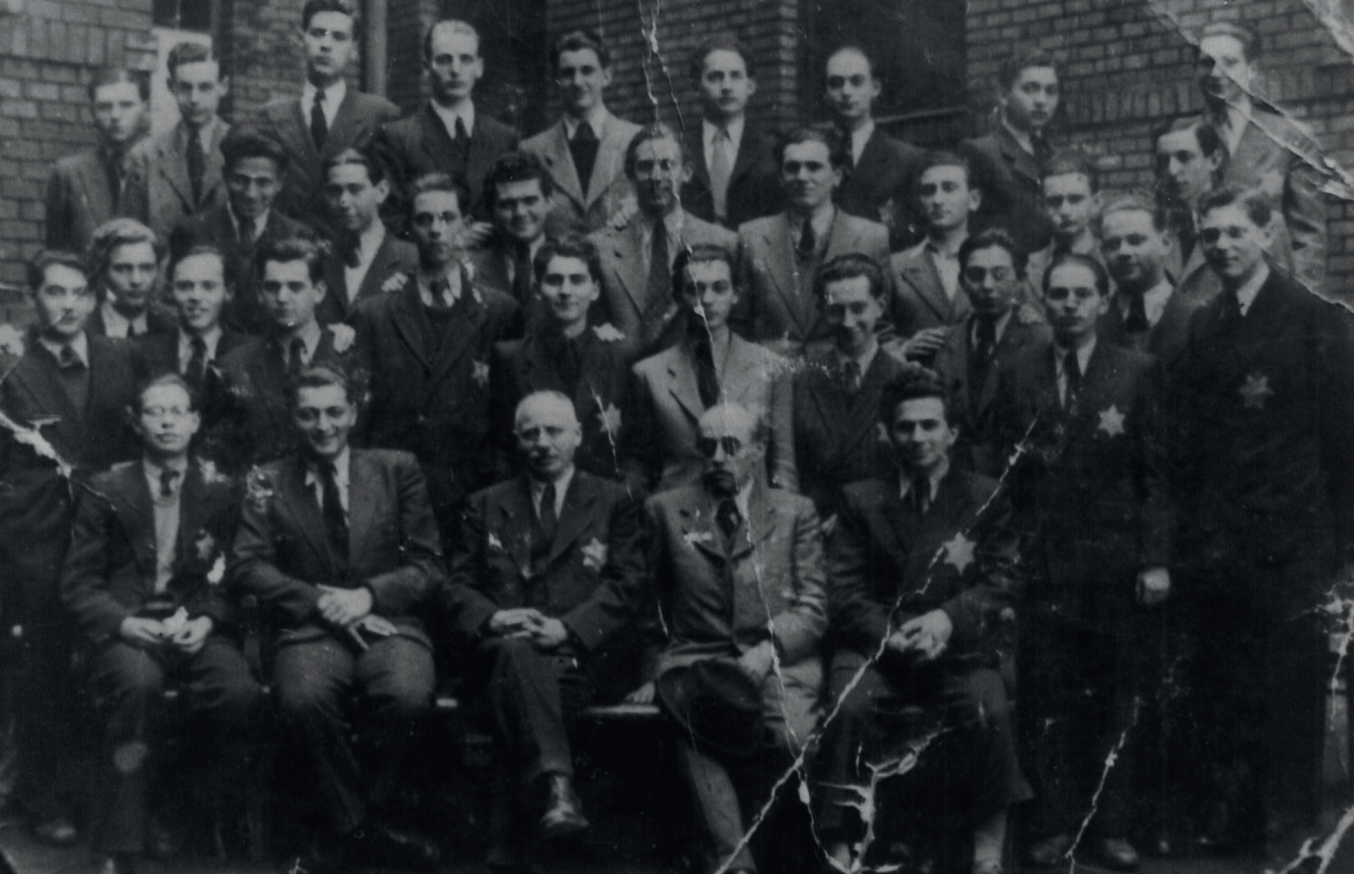
The graduation picture of students and teachers with yellow-stars on their coat taken on the court of 9 Abonyi Street in April 1944, a few months before the arrival of the 101/359 labor service division (Samodai Jozsef Local History of Zuglo Workshop)
REFERENCES
Braham, Randolph L. 2015 A nepirtas politikaja: A Holokauszt Magyarorszagon
[The Politics of Genocide: The Holocaust in Hungary]. Budapest: Park.
Danieli, Dan. 1989. Captain Ocskay, a Righteous Man...: A Research into the
Activities of Captain Ocskay László of the Hungarian Army, during the Years 1944-
45, That Resulted in the Survival of Approximately 2000 Jewish Men, Women and
Children within the Framework of the 101/359 Labor Battalion in Budapest, Hungary.
New York: Dan Danieli.
Fonyo, Gergely, director. Captain Laszlo Ocskay, the forgotten hero. Vox Nova,
2007.1 hr., 9 min.
Goda, Gabor. 1989. Szulofoldem, Budapest [My homeland, Budapest]. Budapest:
Magveto.
Major, Tamas. 1992. “Reszvetem az ellenallasi mozgalomban [My participation in
the resistance]. Ezredveg, February 1, 1992.
