

With Batons and Fists
Written by Zeteny Cseresznyes, Dec 2024
I fell next to him, his body turned over, It was tight as a string when it is stretched. Shot in the head, -- That’s how you’ll end up too, I whispered to myself, -- just lay there in the trench. Patience blooms into death here, -- Der springt noch auf, -- I heard near, Mud and blood dried on my ear.
October 31st, 1944 Miklos Radnoti: Razglednica 4 (translated by Miklos Nadasdi)
*The following article contains references to themes of violance, torture and sexual assault, which some individuals may find distressing.
This October marks the 80th anniversary of fascist terror in Hungary. Exactly 80 years ago, in 1944, Ferenc Szalasi, the leader of the Hungarian ultranationalist Arrow Cross Party (Nyilaskeresztes Part) was authorized to become the new head of government and “leader of the nation” (nemzetvezeto). The last attempt for Hungary to surrender and avoid battle in Budapest against the soviet army had failed. Continuous air-raids, bombings, mass murder and the approaching frontlines caused chaos: armed fascists, SS troops and the Gestapo ruled the capital. Horrible things happened in these places, where hundreds of people now walk by every day without knowing the place's tragic history.
Fascist terror can be best understood by the documentation of war crime trials. Szalasi and other infamous mass murderers were convicted not long after the end of the war. On a local level, however, justice was late or never delivered. In the case of Zuglo, the 14th district of Budapest and a suburban neighborhood, which this article will focus on, it was no different. Investigations started several times in 1945, 1947, 1957 and 1966, but the trial was only celebrated in January 1967. The list of culprits gives away information about the members of the 14th district Arrow Cross Party. Most of them were young adults at the end of 1944, e.g. the youngest member was only 16 years old (Gyula Monostori-Michalik), and the oldest was 46 (Janos Eros). Of the nineteen culprits, fifteen were workers and amongst the remaining were a few artisans and soldiers. Sources state that around one hundred people attended the events of the 14th district Arrow Cross Party in 1944. They worked in nearby factories like the Telephone Factory on Gizella Street and Danuvia Steel Works on Angol Street and had good relationships: the “old” members went to football matches and the cinema together. They were ordinary people with jobs, a family and interests.
On October 15, 1944, the day fascists seized power in Hungary. Members of the Arrow Cross Party were armed and organized into brigades to maintain control and assist in the deportation of the Jewish population. The leader of the 14th district brigade was Laszlo Szelepcsenyi. There were three groups in total and each consisted of approximately twelve people, led by Janos Eros, Elek Nagy, and Gyula Szepcseri. The purpose of the brigades was the round-up of Jews from yellow-star houses (csillagoshaz), which specifically functioned as mandatory residency, and to transfer them to larger collecting points for deportation to concentration camps. Collecting points in Zuglo included the school building on Abonyi Street and the Arrow Cross Party’s 14th district headquarters at 80 Thokoly Street. Other collecting points and camps were at Tattersall (7 Kerepesi Street), a horse racetrack and the football pitch of KISOK (Regional Center for Secondary School Sports). The fascist brigade, police and the army usually accompanied the escort.
The Arrow Cross brigade also functioned as law enforcement of the fascist state aiming to apprehend “enemies of the system” during raids. Anyone’s home would be searched without notice if they were found suspicious. All their valuables would be taken from them and their papers checked for any mistakes. If the person resisted, they were considered to be unreliable or there was something wrong with their papers, they were taken to 80 Thokoly Street. “There were plenty of cases, when members of the brigade dragged people from their homes or yellow-star houses to the office, then executed some of them later that day” ((Historic Archive of the Secret Services) Allambiztonsagi Szolgalatok Torteneti Leveltara (ABTL) V-153693/1,257.)
Due to the overall chaos and uncertainty caused by the nearby frontlines, the early discipline of the 14th district brigade had completely vanished by November 1944: members were overcome by their emotions in many cases and became increasingly violent. They had different conflicts with other authorities, because many of their actions were found illegitimate. Torture was starting to become not only an instrument of interrogation, but initiation and entertainment. The “masterful” interrogation style of Vilmos Kroszl, a member of the Arrow Cross, was beating people with batons and hoses until they confessed.
Interrogations took place mostly in the basement, where people were often held captive for days. When prisoners were freed, they were threatened “not to speak of what happened in the basement” or “if they were seen once again, they will end up dead in the Danube.” The opposite case was not rare either: Hungarian fascists believed that authorities were not efficient with “clearing the Hungarian society from Jews” (zsidotlanitas), so they took matters into their own hands. Executions were held in the basement of the office, the nearby City Park (Varosliget), the bank of the Danube or Rakos River. People were forced to lie down on their chest and got shot in the back of the head. Their bodies were scattered all over Budapest or thrown in the Danube.
While male prisoners ‘only’ had to bear the inspection of their genitals, females had to suffer much more than the body searches. One time, when Janos Hollay, a member of the brigade went down to the basement, he witnessed that 8-10 female prisoners were forced to dance in circles, while three members of the brigade, Gyula Bugar, Kalman Barath and Sandor Gelencser were shouting at them. A similar case happened, when three female prisoners were forced to dance while Szelepcsenyi, Kroszl and the Vigh brothers were shooting guns at their feet. After that, they were raped, beaten up with four other women and murdered in City Park. Another time, the Arrow Cross brigade “directed a show fuck” (diszbaszas), when female and male prisoners were forced to have intercourse with each other.
To fully grasp the dynamics of the terror of the fascist brigade in the 14th district, it is essential to delve into details of two specific events: November 12th and December 24th. Members of the 14th district Arrow Cross Party celebrated the formal opening of their office and the anniversary of seizing power on November 12th, 1944. Earlier that day, eleven Jews were found hiding at 24 Zsalya Street and were kidnapped. Gyorgy Bukkos, the propagandist of the Arrow Cross, remembered that they “celebrated the one-month anniversary of fascist power in Hungary with a luxurious dinner.” ((Archive of Budapest Capital) Budapest Fovaros Leveltara (BFL) XXV.4.a. 1967/4831, I.) Kurt Rechtmann and Bela Toth, leaders of the Arrow Cross Party attended the dinner. After guests left the building, Szelepcsenyi put an armchair in the middle of the room, and three female prisoners were brought up and were undressed. Jozsef Tallos beat their breasts with a wooden stick before Laszlo Bali and Kroszl raped them. Then three male prisoners were brought up and were forced to have intercourse with the female prisoners “with batons and fist.” Szelepcsenyi got up from the armchair after a while, shot a gun in the air and shouted “Enough!”, then walked up to one of the female prisoners and said: “you are a Jew after all.” Then he collapsed in his drunkenness.
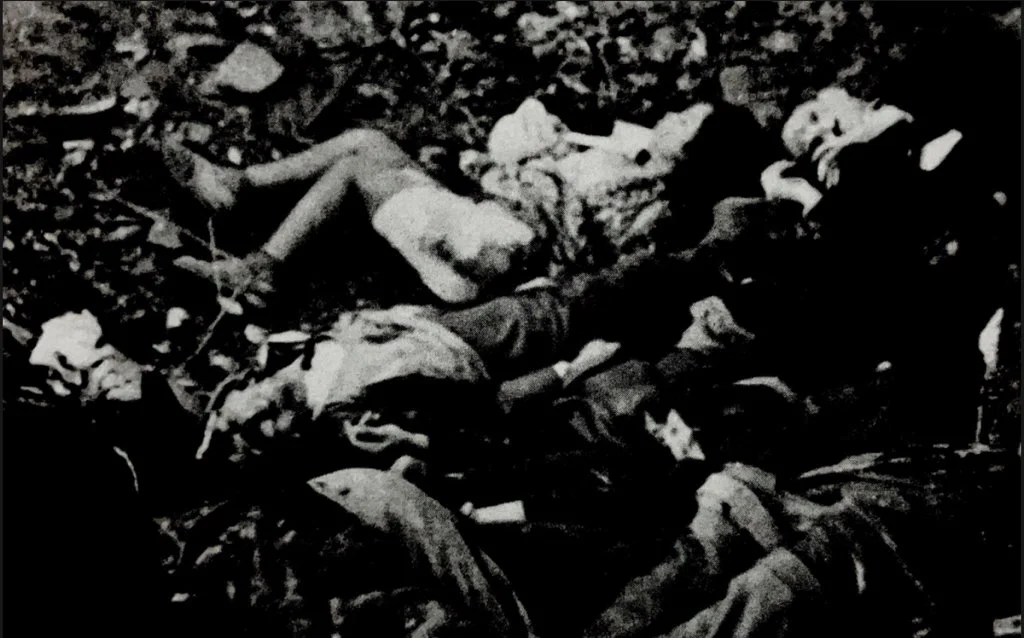
December 24th, 1944, was the day of the fascist “Christmas party.” Bukkos asked every attendee not to give up fighting for victory. Around ten in the evening, Szelepcsenyi sent home the relatives of the Arrow Cross brigade, cleared the tables and brought up some prisoners. One of them was beaten up by Bugar using boxing gloves. Later, two prisoners were forced to fight each other, while members of the brigade were drinking heavily. Then Szelepcsenyi insisted to play “star kicking,” (csillagrugas) where paper was put in between a prisoner’s toes and lit up. After that, some female prisoners were raped in the office. Szelepcsenyi conducted a loyalty test, where all members had to go to the basement and began torturing the prisoners. He started shooting and two prisoners accidentally got shot at the same time, which really entertained the brigade. The second one was still alive, but then got shot in the back of the head. Then the mass execution of prisoners began partly in the basement, the laundry room, and the garden. Others were made to sit down on the benches in front of the office and were shot in the back of the head. Their bodies were thrown in a shell-hole on the pavement. Seventeen bodies were discovered by a civilian the next morning.
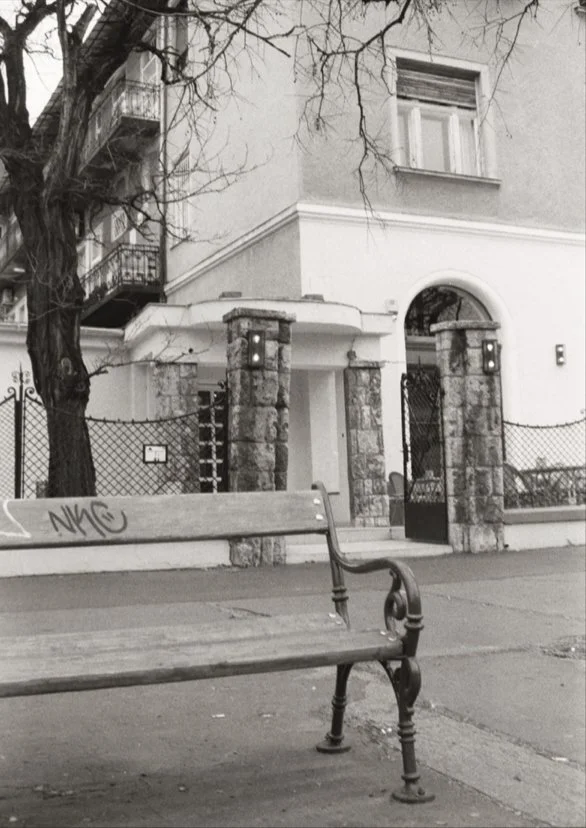
In front of 80 Thokoly Street, against the building there is a bench where people often sit while waiting for the trolleybus. With their backs turned to a location of mass murder, most of them will never know what had happened in that exact same place 80 years ago.
The research was conducted in archives and libraries in 2022 and 2023, with the help of Holocaust Documentation and Memorial Center (Holokauszt Dokumentacios es Emlekkozpont) and the Samodai Jozsef Local History of Zuglo Workshop (Samodai Jozsef Zugloi Helytorteneti Muhely). (This article appeared in Hungarian cultural-political newspaper Magyar Hang in February 2024, and re-revised with the help of Agnes Dios-Toth, Guido Ugo Sitzia and Una Glatz. (Cseresznyes, Zeteny. “Gumibottal es okollel” Magyar Hang. February 2, 2024, Idogep 2-3.))
