

Ambassador Cornstein: Everybody I Met At The Government Wishes For CEU To Stay
By ZOLTÁN MARCELL AGUERA, November 2018
Former businessman David B. Cornstein is the new United States ambassador to Hungary. He has never been afraid of anything, but apparently not even such confidence is enough to achieve his goals: the agreement with CEU still has not been signed by the Hungarian government. However, he already sees the light at the end of the tunnel.
Here, Ambassador Cornstein gives an exclusive interview to The Stand.
It’s now more than 100 days since you have officially become the US ambassador to Hungary. What are your impressions of Hungary and especially of Hungarians?
David Cornstein: I love it from the bottom of my heart. I love the food but I think the wine is better than the food. It’s just a marvelous place. I’ve just met terrific people, other than you.
What motivated you to become a diplomat?
D.C.: I wasn’t thinking of being a diplomat until I received a phone call from the White House last July and I think the experience that I had in life, public service and business, hopefully it served me well to go forward in this role. But I wasn’t thinking about when I was at your age already or at any time. I also had the chance to meet former ambassadors who, before becoming diplomats, worked also as businessmen and they worried about the new task.
D.C.: I haven’t been afraid of anything of my life. Fortunately the good Lord has given me a great deal of confidence and I think that’s important–regardless what you do–that if you feel confident then you can do the job. Although I didn’t have experience in diplomacy, you have to be a bit of a diplomat in business. So I felt I was prepared for it.
You had a public lecture at CEU where you said that now you’re focusing only on the issue of CEU. Do you see the light at the end of the tunnel?
D.C.: I think you can. It’s certainly an urgency. Certainly the students need to know where they’re gonna attend school and the professors have to know where they are gonna teach.
Just the timeframe for that I suppose the decision could be postponed again. But I think everybody agrees, I believe, that it’s time to bring this to a close and find out what the future of the university is.
CEU students are confused: another American university functions in Budapest, the McDaniel College, but apparently they don’t have any issue with the government.
D.C.: I’m as confused as the students. I think that this is a subject that very, very few people really have a deep knowledge of. It really all boils down to can you work this out, if it’s gonna be acceptable to the government and to the school. We are working together to see whether it can get accomplished.
The agreement is ready to be signed for CEU as well but the Hungarian government doesn’t seem to be in a hurry.
D.C.: You’re correct but there’s a lot of ways to get a result. That’s one way of getting there but there are other ways as well. And we are exploring many ways to try that the university stay. I’m concerned, the American people and government are concerned so this something they would like to see to happen for sure.
Isn’t the unspoken truth that the Hungarian government wishes to close CEU because of its founder?
D.C.: George Soros put in 500 billion dollars to start the university, that’s a fact. It’s a fact that the prime minister and George Soros has different views about different subjects. I believe that the government position is that they would like to have the university to stay here and I believe that the university’s and the board’s position is that they would prefer to stay here. So both side would like the ‘stay’ and they have to find the way to achieve a common result.
Can you please confirm the government wishes for the university to stay in Hungary?
D.C.: Everybody I met at the government is very pleased with the university and they would still support staying than going anywhere else.
Everybody at the government. So as the prime minister?
D.C.: From the Prime Minister down.
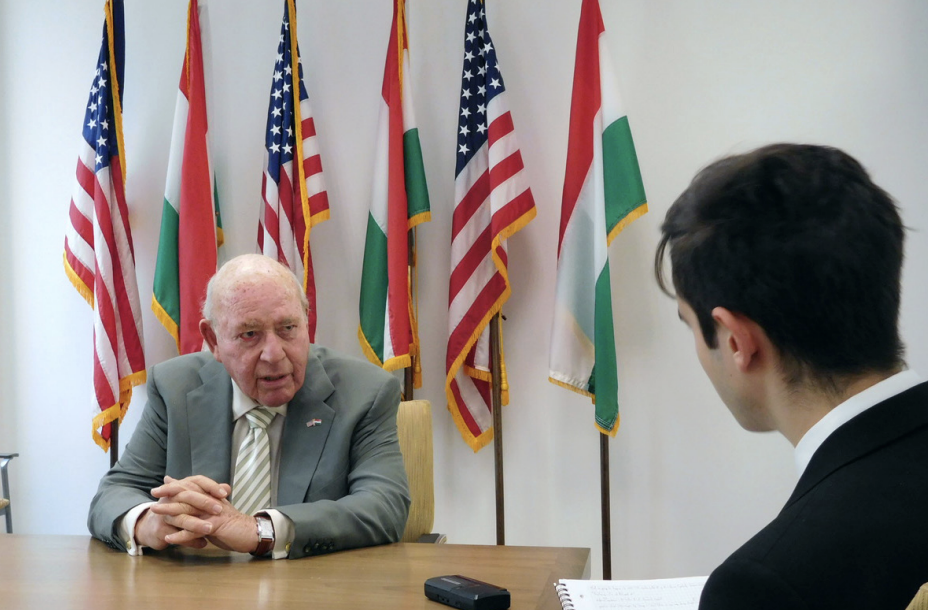
Photo Credits: Zsuzsa Larsen
You had a 2 hour long meeting with the Hungarian prime minister. Can you give us some insights about his thinking about CEU?
D.C.: The 4 points I have made known when I got here are CEU, a defense cooperation agreement, the energy issue, and the dispute with Ukraine. I’m hopeful that all four issues will be resolved. We are not asking for the benefit of the US but because it is in the best interest of Hungary. And we are here to assist Hungary.
Hungary is in a unique geopolitical situation therefore it is strongly influenced by the Russian Federation. Is the US government afraid of this relationship, which is getting stronger?
D.C.: I’m not really worried about it but I can’t speak for everyone in the government. You have to be realistic about where you are in the world. Like one of the areas we are concerned about is the energy issue. It was not good for the US to at one point get all of its energy from the Middle East. You (Hungary) receive 80% of your energy from Russia and I understand that. But I also understand that it would be better for Hungary to diversify its energy from other sources beside Russia and we are working on the pipeline from the Black Sea from Romania and liquid gas from Croatia. And then you don’t have to be as observant to another country.
Can we expect a meeting between President Trump and P.M. Orbán in the near future?
D.C.: I don’t know what the near future is but what I see is the 180 degree turn from the Obama administration. The day before I left Washington I was at the Oval office with the President and I said it would be perhaps good to call the prime minister to congratulate for the recent election. He thought it was a great idea and the morning after he called him.
A common point between the Hungarian and the US government is the policy against the migration flow. However, both states were condemned by politicians and freedom right institutions. What is your response to these critics?
D.C.: I think that the first role of government is the security of the people of the country. On September 11 I lost four of my good friends and I don’t want to see it again. People wanna choose the people who to live with, they want to make sure that they are people who are not gonna endanger the country. So securing the border and allowing the people that you would like to have come in to your country is I think a good point between the two leaders.
Migrant children separated from their parents were put into cages in Texas. Isn’t that controversial?
D.C.: If you see a picture of a baby looking at her mother or see a boat and people drowning off the boat coming from Africa to Europe then if your heart doesn’t go out you are not a human being. It’s terrible. But sometimes if you let everyone in, who don’t have any way of checking out, are these the people who say they are? And what their background is? I don’t think there’s anything wrong with having a system that lets in law-abiding people who can contribute to our society.
What is the most challenging and most rewarding parts of being a diplomat?
D.C.: The most challenging is like in a business, where at the end of the day if the register rings mean that you did a good job. Here if what your goals are the four issues I mentioned, it can be challenging. My biggest challenge however is trying to get government to work like a business, is the biggest challenge. And the most rewarding is being here. It’s an honor to serve in Hungary.
Do you have any advice– as a successful businessman and diplomat– for the students interested in these careers?
D.C.: First I would say, don’t care about the years until you graduate. This is a very, very unique time in your life, don’t let it pass by too quickly. And if you don’t go exactly where you wanna go, maybe you will be a journalist at The New York Times and write bad articles about me, but if you don’t know where you are right now, that’s fine. Like I said I wasn’t planning to be a diplomat, and even at the age of 80 you can start a new career. Have fun with your life!
