Hic fuit – Graffiti from the past
Written by Zoltan Marcell Agura, January 2019
It’s on a sunny afternoon in mid-August that I pack my pencil, a booklet and a flashlight in my backpack. My destination is a five-hundred-year-old chapel located in my hometown. The historic city of Esztergom is famous for its picturesque landscape, medieval old-town, and for the massive Basilica on the castle hill. Only a few visitors, however, know that one part of this huge cathedral hides something unique and unusual: a medieval chapel with more than a thousand carvings on its marble walls.
The Bakócz-chapel was built by Cardinal Thomas Bakócz in 1507. He was a wealthy and influential priest who also worked as the personal advisor to the Hungarian King Matthias Corvinus. His voyages to the Vatican exposed him to the new waves of art emerging in Italy. He decided, therefore, to bring talented Italian artists and architects to his Hungarian residence in order to build his own burial chapel. The Bakócz-chapel was built, and as the only building surviving the Ottoman invasion, it also became a symbol. Soldiers from both sides of the conflict chose a unique way to be part of the history: carving their names on its red marble wall. However, writing names, drawings and symbols remained a local tradition until the 20th century. Thus for today, these walls became an old “guest book”.
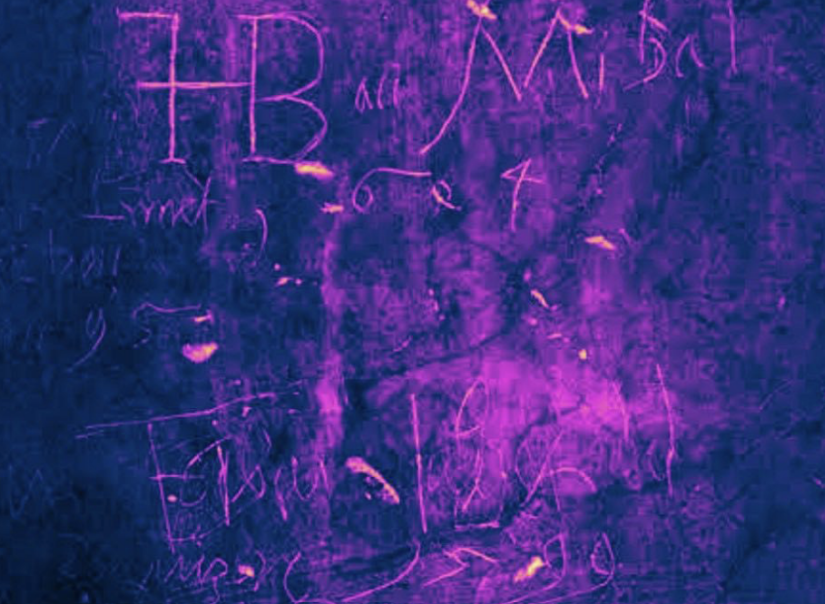
As a local student, I have been trying to be actively present in promoting and protecting the cultural heritage I was surrounded by. That’s why I decided to collect all of the “medieval-graffiti” and look for those ‘hooligans’ who made them. I already knew that by using conventional and UV light, carvings become easier to read. During the two-month intensive research project, more than 1200 individual carvings were documented.
The earliest one dates back to 1595 when the joint Hungarian-Polish army captured the city for a short period. Needless to say, that the other important year, 1683 (when Esztergom was definitively recaptured) also left its mark on the chapel. So far, only a few person’s names have been revealed, mainly because of the hardly legible letters and the deficient documentation at the time. However, let me share you my preliminary findings.
Our first ‘vandal’, Paulus Matula “advertises” himself with huge letters opposite to the altar — which is quite controversial since he was a supreme judge from southern Hungary. During the war of independence against the Habsburgs (1703–1711), he became a soldier and joined a regiment. Our hero, however, changed his mind quite quickly by deserting and changing side. Probably this is the reason why he was caught and later beheaded in Buda.
Among the other notable names are Zÿllÿ Gergel, or as we would call him today, Gergely Szili, who was a castellan in the city of Pápa. Other names on the walls include Georg Knobloch, a local bellfounder in the 18th century, or Petrus Gregoroczy, a Croatian noble descent and a high official (master of the table) of the royal household in the 17th century. Polish names are just as frequent ornaments on the walls as Hungarians. A good example is Stanislaus Wolsky, who accompanied Princess Isabella Jagiellon to her own wedding with John Zápolya, King of Hungary in the 16th century. Our Polish actor probably also took part in the battles against the Ottomans.
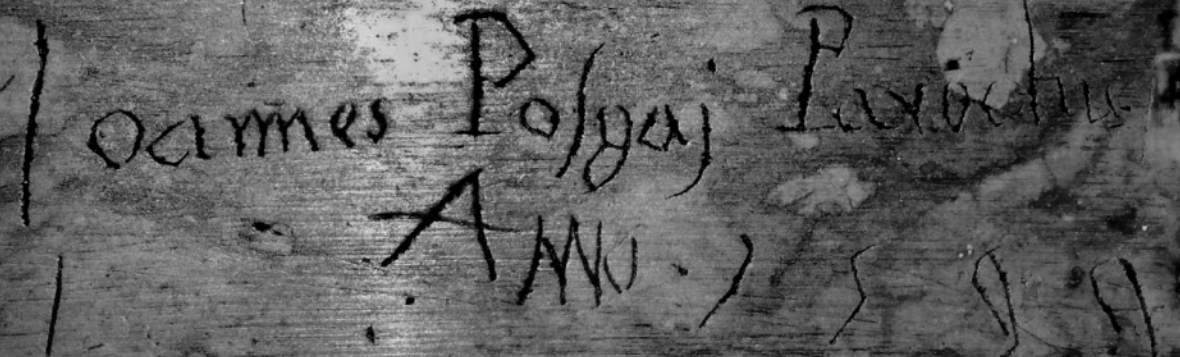
Numerous names are referring to canonical personalities, such as László Lékai, cardinal of Hungary (1976–1986) or Ioannes (John) Posgay who was appointed to the Archbishop of Bosnia (1623) by the Holy Roman Emperor, Ferdinand II.
Although the findings are far from being groundbreaking in terms of archaeology, at least a slight part of the history has been unfolded by analysing the red marble guest book of this medieval chapel.