

An interview with Péter Molnár, the creator of the Hate Speech Monologues
Written by Israel Collier, March 2019
Ever heard of the “Hate Speech” Monologues?
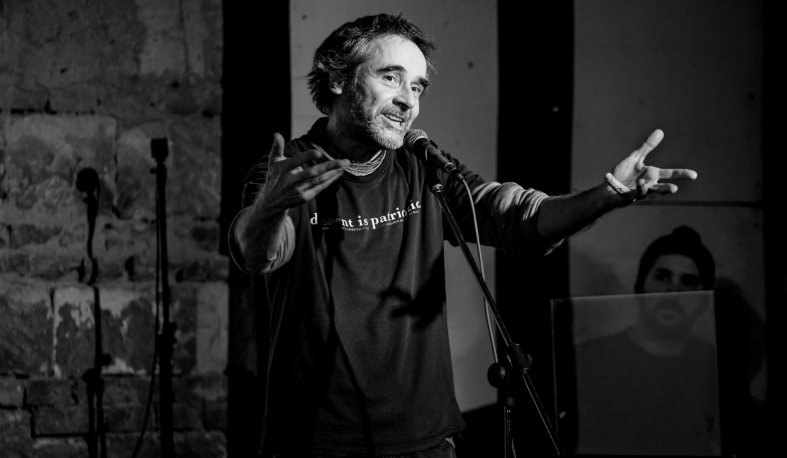
I’m sure you have. Dr. Péter Molnár, the current European slam poetry champion, in his dutiful perseverance, recruits students who are willing to tell their truth about how they face prejudices. When I met Péter last fall at Welcome Afternoon, I was ecstatic about the idea of expressing and sharing my own spoken word.
Students are encouraged to express their truth during the monologues, to exercise their freedom of speech. Péter is very soft-spoken, approachable and warm, so when he began to unravel the details of his tumultuous 15-year roller coaster ride here at CEU, I was often floored by the details. And after my interview with the infamous Péter Molnár, the story began to unfold further, layering the complexities of once being prime minister Orbán’s roommate at university, studying both law and aesthetics, co-founding Fidesz, becoming member of Parliament for 8 years in 1990, teaching courses on freedom of speech at university and writing a short novel that later became an award-winning play.
He became one of the founding researchers of the Center for Media and Communication Studies (now the Center for Media Data and Society), and collaborated with the Department of Public Policy (now the School of Public Policy, SPP). Before 2004, there was no media-communication studies at CEU.
So you’re the original Jeremy Braverman?
Péter laughs.
It could be. Although earlier I worked more on the constitutional limits to “hate speech”, increasingly, I have focused on artistic responses to prejudices, and as a performer I have helped students to develop their performing skills on the platform of the “Hate Speech” Monologues, and also in slam poetry, as Jeremy helps them to develop filmmaking skills.
Communication was important in the name of the Center as it is broader than media. For example, demonstrations are a classic form of freedom of speech, not media, it’s speech. Freedom of speech is broader than freedom of the press. When we started the Center, there was no money. We had one or two rooms. I was building that Center for a decade as Senior Research Fellow, without a job contract, often with voluntary work.
My main work was to lead one of the major projects that we started at the beginning on so-called “hate speech”. It resulted in a book that I co-edited, The Content and Context of Hate Speech: Rethinking Regulations and Responses, by Cambridge University Press in 2012. I also authored 5 chapters of this book which was in the research focus of the CEU website. Aryeh Neier, the legendary human rights leader wrote a very supportive review about it.
As CMCS offered courses for the Department of Public Policy (DPP), I started to teach on issues of freedom of speech and access to information until 2012, when I was asked to focus my course on so-called “hate speech”. I was glad to do it. In each class, I asked participants to do something I called real-life exercise which means that of course we did all the usual course work, but my idea was to test the ideas that we discussed in the classroom.
In that sense, my course, besides an in depth academic course, was always kind of like a human rights action group as well. It was really good because many of us wish to do nice things to improve human rights and fight discrimination but so often we don’t have the time and energy. In the case of the course, we were there! We dedicated instituted time for this.
He lights up.
That’s when I started the “Hate Speech” Monologues.
When I started my course on enabling policies for responding to “hate speech” in practice, I already started to become a slam poetry performer, with an anti-racist pro-diversity slam poetry night that I arranged from New York with live internet connection with Budapest in 2010. When I first focused the course on “hate speech”, I created the HSM as an artistic platform for real-life responses to real-life examples of “hate speech”, sharing personal experiences on how participants have faced prejudices and how they were able to respond.
I figured out the title: “Hate Speech” Monologues, inspired by the title of Vagina Monologues. Although with HSM performances, the performer is telling her, or his own stories, and is the one who decides what she or he has to say and what style. We did the first performance in March 2013.
After you completed the book, did you continue the program at that time?
Yes, I have continued my work, but very sadly, soon after publishing the book, starting the course and the performance, all focusing on responses to “hate speech”, in a marginalized position. A nightmare started some 5 years ago. Before he arrived to CEU and without even meeting me first, I was severed from the CMCS by then Director Philip Howard.
I pursued a complaint under the Code of Ethics, but it provides that the basic values listed in its preamble do not mean to restrict powers of those authorized to make decisions about the work of others. Suddenly, I was out of CMCS, with a much weaker affiliation, without an institutional home to which my work belonged.
I could only continue my course until DPP became part of SPP and in the last two years, with a voluntary contract. I wonder whether my work on responses to “hate speech” will ever be recognized again as relevant for the CEU media studies center which recently itself has existed in the middle of massive hate campaigns.
I’ve only heard bits and pieces of SPP... Could you give me a brief history?
With limited information, my understanding was that SPP didn’t build enough on the already successful work of the Department of Public Policy. It created a situation where elective courses like mine were potentially more vulnerable, although for many years I was always invited to the faculty meetings of the department.
Did you get support from students after being severed from CMCS?
As my former Center became part of SPP in 2014, the then recent cut of my affiliation certainly did not help the continuation of my course neither. When I could not continue it, many of my former students signed a letter of support written by two of them from my last course.
Besides my academic experiences, I had a lot of first-hand policy-making experience. As a Member of Parliament I was leading the media and cultural policy of two human rights oriented parties for 8 years.
Really? You were a member of Parliament?
Yes, and I was in the leaderships of two parties, I was one of the Vice Presidents of Fidesz in 1993.
So I’m curious Péter, how have you maintained HSM after being severed?
With a lot of extra work. I have been running around events at CEU to talk to potential participants and supporters. It helped me that I was running around events already as a student at ELTE. I am a very curious and informal person. When there are three events one night at CEU, for example on history, gender studies and public policy, I may try to go to all of them.
How many students have performed “Hate Speech” Monologues?
It should be at least above 200 performers. Some students perform more than once. Since last spring, it’s about 4 performances a year, as additionally to the traditional fall and spring performance, I am very glad that Roma students initiated that I do with them Roma editions of the HSM.
Why do you think they wanted to discontinue the “Hate Speech” Monologues?
When I was told that it may discontinue, there was no reason attached. Although I was hoping that it was only a result of lack of information and/or misunderstanding (also as last fall, I became both the Hungarian and the European Slam Poetry Champion—which is certainly relevant for working with students on a performing platform), I had to take it very seriously.
The Szabad Egyetem Collective wrote and ran a petition that requested not only the continuation of the HSM, but also to bring back my related course to the curriculum as part of creating more institutional support for my work. Building on this petition that many CEU students supported, and also on the support of many faculty members, departments expressed their willingness to support bringing back the course with which I started the HSM.
I had a very helpful meeting with the Rector on Friday, January 18th. He has supported the HSM since he saw it in March 2017, when he gave really thoughtful welcoming remarks before the performance. As we speak now, I wait to hear about the result of negotiations with the supportive departments and the Dean of Students.
I am very grateful for all the support. I am hopeful that I can continue the HSM, with proper affiliation, and from the next academic year again with the course that would especially support the participation of disadvantaged students in the performances.
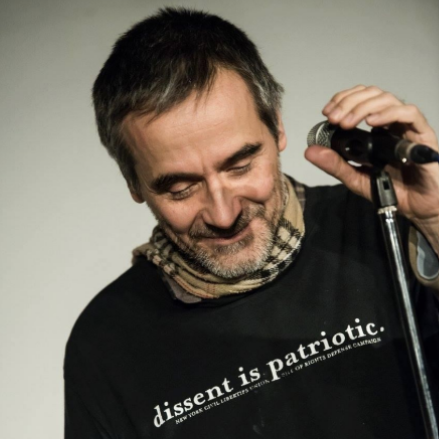
“I feel like the ‘Hate Speech’ Monologues gives CEU students a platform to make their voice heard on topics and issues that are not commonly talked about. I did my piece on my coming out story. Coming from a conservative country like Albania, this was an indispensable opportunity for me to tell my story. Having the ‘Hate Speech’ Monologues cancelled takes this opportunity away from so many future students longing for a platform...”
— Bruno Hasa
