

Hungary’s Paprika People: A search to understand the Hungarian love for this spicy pepper
Written by Talia Dunyak and Zoltan Aguera, March 2019
Hungary: a land known for many things: spas, palinka, ruin bars, but most of all paprika. Since moving to Hungary, many Central European University (CEU) students will have noticed the never-ending barrage of information about paprika. It is hard to escape the peddling of paprika while walking past the stores on Vaci Út or past the dozens of paprika stalls in the Great Market Hall. Surrounded by the pyramids of paprika, an unknowing bystander, such as myself, may not understand the Hungarian obsession with this spicy pepper. Hitting the streets of Budapest, my mission was to find the answer to one burning question: Why are Hungarians obsessed with paprika?
Although the Hungarian love for paprika might seem genetic, paprika is not an indigenous plant to Hungary. The sweet and spicy peppers originated in the “new world,” primarily from South and Central America, meaning that this vegetable was not brought to Hungary until the 16th century. At the beginning of the paprika’s time in Hungary, it was primarily cultivated for the aristocracy, but as time progressed, paprika became a cheaper alternative to other spices such as black pepper.
The paprika is tied up with many shining moments of Hungarian culture and innovation. As many CEU students will know, paprika exists and thrives as one of the signature dishes of Hungarian cuisine, lending its flavor to traditional meals such as chicken paprikash and goulash soup. However, not everyone might be aware of Nobel-prize winner Albert Szent-Györgyi, who used paprikas to discover and extract Vitamin-C for the first time.
However, the story of paprika does not exist only in history, but also all around us. Interviewing CEU students, Dóra Lakatos and Flora Kovacs, the true story behind paprika began to unravel. “I just grew up eating it. It’s such a ubiquitous thing in Hungary that really you just can’t get away from it, even if you wanted to,” said Flora. She then added, “The paprika you can buy at stores is not the real deal. My family gets ours from an old lady in the countryside who grows paprika in her garden.”
With the dozens of shops and hundreds of Hungarian grannies growing their own paprika, not to mention the sheer variety of the spice, it can be hard to know where and which paprika to get. With translation help from CEU student Zoltán Aguera, The Stand talked to Zsuzsa, a paprika sales lady at the Great Market Hall. Standing under a large blue and red sign which reads “Mak Darálva is Kaphato,” Zsuzsa was able to shed some light on the paprika situation.
“The most popular types of paprika are the smoked ones and the ones that come in glass jars, like Erős Pista,” Zsuzsa stated. “The smoked ones have only become popular in the past two or three years though, and most people like the pastes because that is what is in the restaurants and it’s easy to cook with.”
Echoing Zsuza’s recommendation for Erős Pista, Dora also suggested another method of eating paprika for those who really want to feel the heat: “Sometimes I just have a spoonful of grinded paprika (Erős Pista) on its own!”
When asked about which paprika types to buy, Zsuzsa recommended using smoked paprika for barbeque meats, sweet paprika for salads and fish, and hot paprika for goulash and other typical Hungarian food. Sometimes though, paprika isn’t just used for its flavor but also its color; paprika’s deep red color can do a lot to make a dish look more appealing and dramatic.
In addition to all the Hungarian delicacies that benefit from a hint of paprika, some non-traditional foods also benefit from a dash of the spice, as well. “The best non-Hungarian food to add paprika to is scrambled eggs! It’s truly the best,” Flora enthused.
Zsuzsa, whose family has sold paprika in the Great Market Hall since the 1950’s, also stressed the importance of buying Hungarian paprika. “Hungarian paprika is not mass-produced. For many families, including mine, paprika is a family business.”
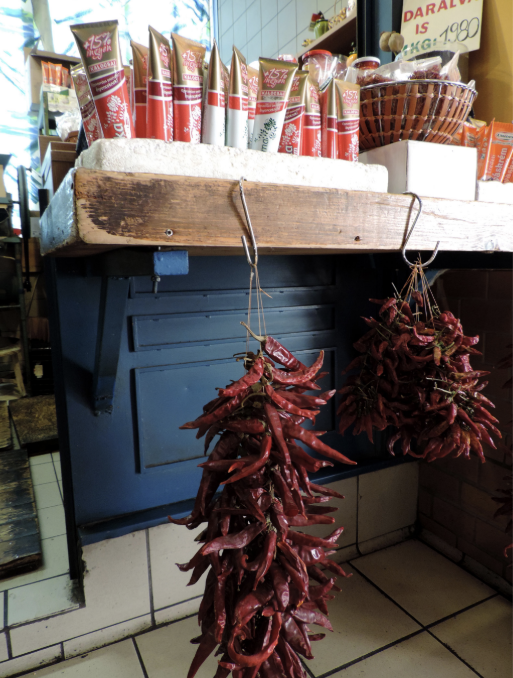
With all the agriculture throughout Hungary, paprika is often grown on family-run farms as opposed to mass-produced. The towns of Szeged and Kolacsa, and the regions surrounding these towns, are particularly well-known locations for paprika cultivation. For many, these farms and practices are passed on from generation to generation, one of the reasons that paprika has transcended from a simple spice to a Hungarian obsession.
However, it is not only because of this generational connection to the production of paprika that Hungarians have become known for the spice. Paprika has become known as a “Hungaricum,” or something that is unique to Hungary. Although you wouldn’t be able to argue that paprika originates in this Central European country, it is evident that it has become part of not only the economy, but also the culture.
With paprika permeating many of the national dishes, it also has weaseled its way into the hearts of many. Both Flora and Dora reminisced on cooking with paprika and eating paprika filled dishes with their families. Flora told The Stand, “It’s a must to include paprika in any sort of soup or stew.” Dora agreed with Flora saying, “My family always includes paprika in our soups, too.”
Regardless of the “how” and “when” paprika gained national prominence in Hungary, it continues to hold a special place in the hearts of those who live and visit Budapest. For Hungarians, it’s a spice full of tradition and for the visitors it’s something to remind them of the amazing times they spent in Hungary. A spunky spice for the paprika people.
And as a parting kernel of wisdom, Dora advised us that, “After an exhausting day of reading the news my soul gets numb. Paprika makes me feel alive again.”
