

CEU’s Sexual Harassment Policy Explained
Written by Jennifer Edwards
Credits to Jennifer Edwards
Sexual harassment on university campuses is a serious and ongoing issue. There is no published data about harassment at CEU, but a 2015 survey of 525 graduate students at a large research university in the United States found that 38% of women and around 23% of men had experienced sexual harassment from their faculty or staff, and 57% of women and 38% of men experienced harassment from other students over the course of their graduate studies. Other surveys of graduate students in Europe and the United States have obtained similar results, and it’s possible to extrapolate that CEU likely has similar rates of harassment. CEU has a fairly robust anti-harassment policy in place, with a bureaucratic system of reporting that few know about. This article is an attempt to clarify that and provide tools and resources within the university for anyone who has experienced harassment and would like to initiate mediation and reporting procedures.
The official policy can be accessed at https://documents.ceu.edu/documents/p-1402-1. To briefly summarize, CEU’s definition of harassment is “the creation of an offensive, degrading, or intimidating environment, in which conduct, because of its severity and/or persistence, is likely to interfere significantly with an individual’s ability to participate in, or benefit from, his or her educational or working environment by negatively affecting the person physically or emotionally.” Harassment can be physical or verbal, and can vary in severity.
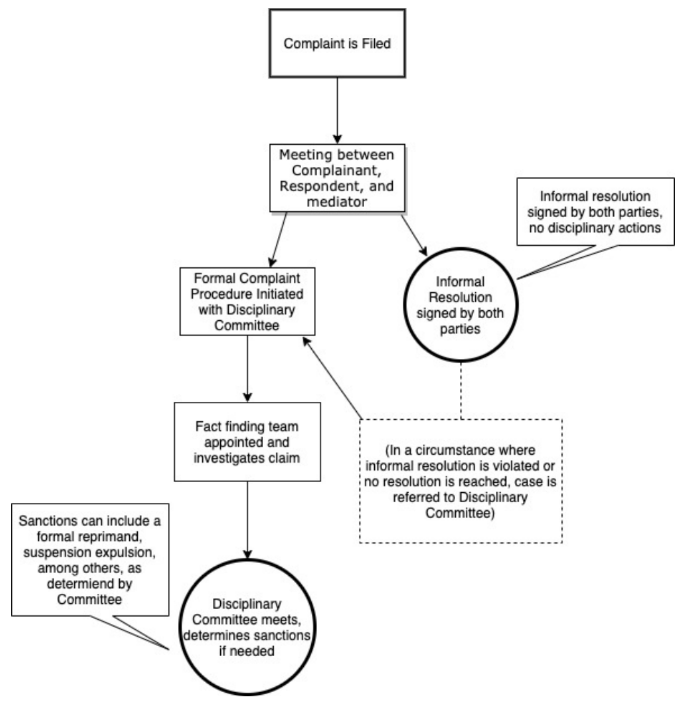
If you feel that you are being harassed, or that someone you know is, and you would like to report it, there are two possible different routes which you can pursue. Both processes begin with filing a complaint to one of the Unit Heads, the Dean of Students, or with the Provost. You can file a complaint any time within four years after the last incident of sexual harassment. A complaint may be filed even if you are uncertain whether the conduct of another rises to the level of harassment prohibited at CEU. The complaint can be written or given orally, in which case a written complaint will be created with the help of the person you are filing the report with. Within 20 days after the complaint is filed, a meeting between the complainant (the person filing the complaint) and the respondent (the person the complaint is about) is organized, and it is decided what procedure will be followed from there.
The informal complaint procedure resolves the situation by informing the respondent of their inappropriate behavior, the situation is then discussed, and the respondent apologizes and agrees not to continue the behavior in the future. An informal resolution will be drafted in writing after the meeting between the respondent and the complainant and will be signed by both parties. The respondent may be required to participate in counseling, training, or other education about the issue. No disciplinary actions are issued in this instance, but if future problematic behavior occurs with the respondent, this resolution may be used as evidence of past behavior.
The formal complaint procedure is begun in the same way as the informal procedure, with a meeting between the person filing the complaint and the respondent. In the meeting, the complainant can request that the case be forwarded to the Disciplinary Committee. The formal procedure can be used when the situation is severe, or if the complainant feels the situation should be addressed by the informal process. The formal procedure will also be initiated in the case where no informal resolution is reached, or the respondent breaches the terms of the informal resolution. In cases of sexual harassment, the Disciplinary Committee will assemble a fact-finding team of two members of the Committee who are trained in investigating sexual harassment claims. At the end of this fact-finding period, the Disciplinary Committee will convene and determine an appropriate path forward, as well as sanctions if determined necessary. Potential sanctions at the end of the formal complaint process include an oral and/or written reprimand, expulsion, suspension, or other sanctions as the Disciplinary Committee sees fit. For more information on the Disciplinary Committee process, please see Part V of the Code of Ethics (https://documents.ceu.edu/documents/p-1009-1v1402-0).
If you feel you have been sexually harassed, please don’t hesitate to reach out to friends, trusted faculty or staff, or counseling services on campus. You do not have to pursue the procedure outlined here, but please know that you are not alone and it’s never your fault.
