

Finding a New Home: Visiting Vienna
Written by Talia Dunyak, January 2019
Vienna, just three hours away by bus and two and a half by train from Budapest, shares some common cuisines, history and now—most importantly to us—shares the Central European University (CEU). In this time of transition for the university, many details regarding the transnational move of the university, including where in Vienna the school will be located, remain to be seen.
While CEU’s permanent Viennese residence at the Otto Wagner Spital—a former psychiatric hospital (designed by the cherished Viennese architect Otto Wagner)—will not be available for several years, CEU continues to discuss possibilities for a temporary home in Vienna. As reported by Der Standard in December, one of the options for CEU’s temporary home in Vienna is 51–55 Quellenstraße in Vienna’s tenth district—Favoriten.
Although the name Favoriten makes the tenth district sound like the possible favorite district of Vienna, most Wieners would disagree with this assertion. In my opinion, some of the negative views about Favoriten are simply examples of thinly veiled racism or ignorance by those who hold such opinions. The tenth is known for being one of the districts with the most immigrants, but in a city where almost 40% of the population is foreign-born, this doesn’t mean a lot.
Some Viennese might also suggest that the tenth district is the most crime-ridden district, but in a city that has been consistently rated the most livable city and one of the safest cities in the world, I’d take that with a grain of salt as well.
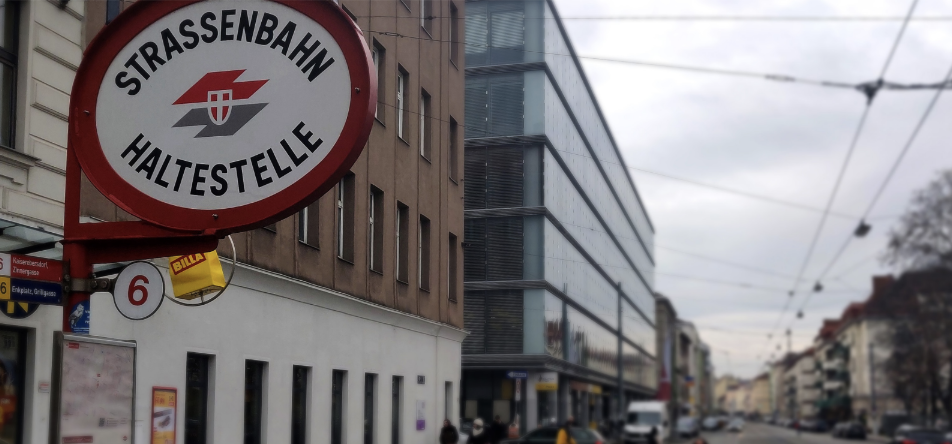
Photo Credits: Talia Dunyak
A First Look at Quellenstraße
While exploring Vienna on a crisp Saturday morning, I made my way to the possible future home of the university to see for myself. Starting my journey in the city center, I jumped on the U1 towards Reumannplatz. The ride was pleasant and smooth. For future students, it remains to be seen if they will qualify for the 75€ per semester ticket for the public transit system in Vienna or if they will have to get the approximately 1€ per day yearly pass instead. However, I used my 2.20€ single ride ticket to get out from the center to the tenth.
After 15 minutes on the subway, I emerged in the tenth and headed down the road to Quellenstraße. According to Google Maps, the journey is about 12 minutes on foot or 7 minutes via Bim (the Austrian word for a tram). Factoring in the wait time for the Bim, I decided to walk. The walk was not altogether unpleasant but on the frigid and windy morning I was there, I was certainly a little more than chilled upon reaching my destination. On the walk there, I passed some Turkish grocers, several creative murals and a few small restaurants and cafés.
The Building on Quellenstraße
Upon arriving at 51–55 Quellenstraße, I found a large and rather imposing modern glass building. Not wholly looking out of place, this building stands out as much more modern than those surrounding it. The structure—a former bank building—takes up almost the whole block and had a rather lonely feeling to it. Under further inspection, I found that the building is located directly on the number 6 tram line, making it more accessible than I expected.
I was disappointed to find that the green space directly across the street was not a public park, but a family swimming pool. However, upon exploring the area around the building I found some nearby small parks, and immediately my mind went to the possibilities for students to picnic there in the warm evenings of the spring semester. Even for a chilly Saturday morning, the area seemed lively, with families out for a walk with their children, people waiting for the Bim, and many folks obviously out doing their weekend shopping at one of the many small stores in the area. Nearby there are several small museums and cultural centers, such as the Brotfabrik, a community space made from an old bread factory.
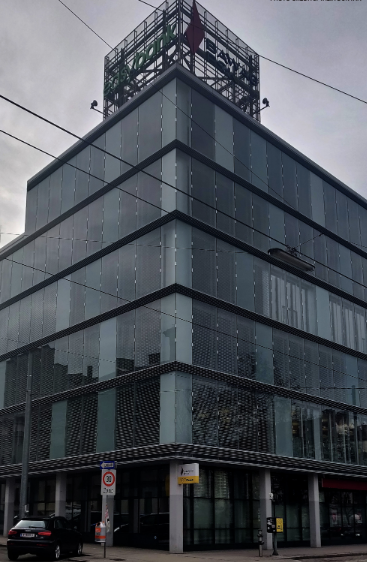
Photo Credits: Talia Dunyak
Imagining CEU’s Future in Vienna
The new building and possible temporary home for CEU felt a little cold compared to the well-loved buildings on Nador Utca in Budapest. But with a little bit of imagination and the hope for sunnier weather, it was easy to envision how this building could be transformed into a proper and cozy home for future CEU students of the coming years. Some of these students, never having sat on the N15 roof terrace in the sunshine or studied in the warm embrace of the library or walked under the beautiful skylight of N9 could be happy here, making the best of a difficult situation.
Although the probable permanent home for CEU in the Otto Wagner Spital, with its beautiful—almost palatial—Jugendstil architecture may be more beautiful than this modern building in the middle of the tenth district, this area has spunk and a spirit to it. The building may not be as grand, but in a time like this, a resilient and dynamic university has got to roll with the punches. As many of the international students at CEU will confirm, picking up and moving to another country is not something easy or something that is going to be done lightly, but when done correctly, it may be so worth it.
In the coming weeks, as we learn more about the move from Budapest to Vienna, and as more is announced and decided about the future of CEU in Vienna, I feel confident that CEU can find its proper home. With the sweet blue Danube river connecting Vienna and Budapest, we can rest assured that we’ll never be more than a few hours by bus, train or boat from CEU’s home for over 25 years.
And CEU, as Billy Joel once said, “Vienna waits for you.”
